
If you run a business with 10 to 200 employees in the UAE, payroll just got less forgiving. Since June 1, 2026, salaries for the previous month must reach employees’ accounts on the first day of the following month, and anything later counts as a delay under the Wage Protection System. That one rule is why many owners who once managed HR on spreadsheets are now searching for HRMS software in Dubai.
This guide explains what HRMS software in Dubai actually does for a UAE business, which payroll and leave rules it must handle, how to compare options without being swayed by feature lists, and what a realistic rollout looks like. It is written for owners, finance managers, and office administrators who make this decision without a dedicated HR department.
What is HRMS software, in plain terms?
An HRMS (Human Resource Management System) is one database of employee records that feeds attendance, leave, and payroll from the same source. The point is not the modules; it is that a leave approval automatically changes the payroll figure, and a new hire’s contract details are entered once rather than in four places.
Small businesses usually buy an HRMS for one of three reasons:
- Payroll accuracy and timing. Attendance, overtime, and unpaid leave need to be settled before the salary file goes to the bank.
- Record keeping. Contract dates, visa and Emirates ID expiry, and salary history need to be retrievable when a labor inspector or an employee asks.
- Less admin on the owner. Leave requests, payslips, and document renewals stop arriving as WhatsApp messages.
In the UAE, “HR software,” “HR and payroll software,” and “HRMS software Dubai” are used almost interchangeably by buyers. Whatever the label, the test is the same: does it hold the data UAE payroll depends on, and does it produce what your bank and MOHRE expect each month?
Which UAE rules must HRMS software in Dubai and Abu Dhabi handle?
Four rules drive most of the payroll work in a UAE mainland company. HRMS software in Dubai does not make you compliant; it makes the calculations repeatable and the records available. Confirm current requirements with the Ministry of Human Resources and Emiratisation (MOHRE) or a licensed PRO or legal adviser before relying on any of them.
- Wage Protection System (WPS) timing. WPS is the electronic salary transfer system through which MOHRE-registered employers must pay wages via approved banks and exchange houses. Under Ministerial Resolution No. 340 of 2026, effective June 1, 2026, wages for the previous month are due on the first day of the following Gregorian month; a company is treated as compliant if at least 85% of total wages due are transferred on time, and enforcement starts on day two with alerts, escalating to a work-permit freeze from day five and fines from day 11 (Khaleej Times, May 2026). For HRMS software in Dubai, this means attendance and leave must be closed and the salary file ready several working days before month-end, not after it.
- End-of-service gratuity. Expatriate employees with at least one year of continuous service are entitled to 21 days’ basic wage for each of the first five years and 30 days’ basic wage for each year after that, calculated on the last basic salary, excluding allowances, and capped at two years’ wages. Entitlements must be paid within 14 days of the contract end date (UAE Government portal). Your HRMS software therefore needs a reliable join date, a separate basic-salary field, and a record of unpaid leave days, which are excluded from service.
- Leave entitlements. Full-time private-sector employees get 30 days of paid annual leave after one year of service, and two days per month once they pass six months (UAE Government portal). Sick leave runs up to 90 days a year after probation: 15 days at full pay, 30 at half pay, and 45 unpaid (UAE Government portal). Half-pay sick days are a common payroll error when leave and salary live in different spreadsheets.
- Unemployment insurance (ILOE). The Involuntary Loss of Employment scheme is mandatory for most private-sector employees, but the premium (AED 5 or AED 10 a month, depending on basic salary) is paid by the employee, with no cost to employers (UAE Government guide, PDF). An HRMS helps mainly by storing the subscription certificate against the employee record.
Free-zone companies should check their own authority’s payroll rules; the DIFC, for example, runs its own wage protection arrangements, and this article addresses mainland MOHRE requirements.
What are the benefits of HRMS for small businesses? A worked example
The benefit of HRMS software in Dubai is fewer manual calculations at the two moments that cost money: month-end and an employee’s exit. The following scenario is hypothetical and illustrative only; it is not advice on any individual case.
A Dubai trading company employs a sales coordinator on a basic salary of AED 6,000 plus AED 2,500 in allowances. Her limited contract ends after exactly 3.5 years of continuous service, with 12 days of unused annual leave.
| Item | Calculation | Amount (AED) |
| Daily basic wage | 6,000 ÷ 30 | 200 |
| Gratuity days (first five years) | 21 days × 3.5 years | 73.5 days |
| Gratuity | 73.5 × 200 | 14,700 |
| Unused leave (on basic wage) | 12 × 200 | 2,400 |
| Final-month salary | Pro-rated by exit date | As per contract |
Done by hand, this takes an hour and depends on someone remembering that gratuity uses basic salary, not the AED 8,500 total, and that any unpaid leave days shorten the service period. An HRMS that stores basic and allowances separately, records unpaid leave against the service period, and holds the join date produces the same figures in a minute, with an audit trail. Across a 40-person workforce with normal turnover, that is the difference between a settlement paid inside the 14-day window and one that is late or disputed.
The same logic applies monthly. If sick leave moves to half pay on day 16, or an employee had four days of unpaid leave, an integrated system adjusts the salary line before the bank file is generated. Spreadsheets rely on someone noticing.
How to compare HR and payroll software in the UAE
Use the same criteria for every HRMS software Dubai vendor and ask for a demonstration of each one on your own data, not a sample company.
| Criterion | Why it matters in the UAE | What to ask for |
| Salary structure | Gratuity and leave use basic wage; WPS uses total | Separate basic, allowance, and deduction fields on every record |
| Payroll cut-off | Wages due on the 1st of the month since June 2026 | Attendance lock date, approval step, and how long bank files take to prepare |
| WPS bank file | Each bank or exchange house needs a specific format | Which banks the vendor has produced files for; confirm with your bank |
| Leave engine | 30-day annual, tiered sick pay, unpaid leave affects service | Automatic accrual, half-pay handling, and manager approval on mobile |
| Document expiry | Visa, Emirates ID, passport, and labor card renewals | Alerts 60 and 30 days before expiry, with reports by department |
| Attendance capture | Shift workers, multiple branches, field staff | Clock-in method (app, device, or manual), and how overtime reaches payroll |
| Employee self-service | Reduces owner and admin workload | Payslips, leave requests, and document uploads from a phone |
| Integration | Payroll must post to accounts; POS staff hours may feed payroll | Live link to your accounting or POS system, not a CSV export |
| Support and pricing | UAE working hours and AED billing | Per-employee or per-company pricing, implementation fee, and support channel |
Weight these by your situation when shortlisting HRMS software in Dubai. A single-office consultancy cares most about documents and self-service. A restaurant group or retail chain cares most about attendance capture, shift rules, and whether the POS and HRMS share staff data.
HRMS software Dubai implementation checklist for SMEs
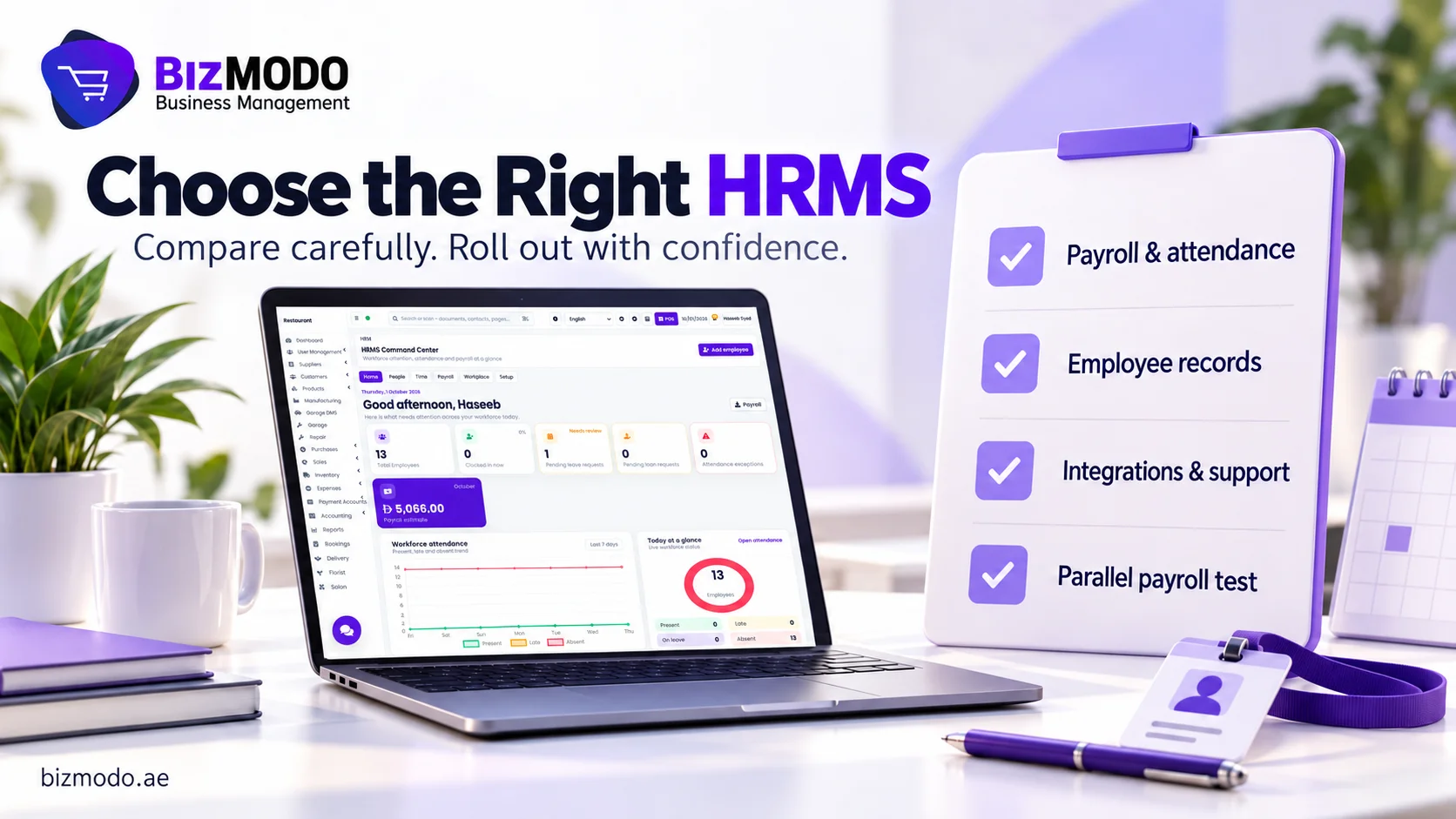
- Export your current employee list and clean it: full name as per passport, join date, contract type, basic salary, allowances, visa and Emirates ID expiry.
- Confirm with your bank or exchange house what salary file format it accepts and how many working days it needs before the 1st.
- Define leave policies in writing before configuration: accrual start, carry-over rules, and who approves.
- Run one parallel payroll: process the month in both the old spreadsheet and the new system, and reconcile every difference before switching.
- Set document-expiry alerts and assign an owner for renewals.
- Train managers on approvals and employees on self-service in the same week; adoption fails when only the admin is trained.
- After the first live payroll, review the audit log for manual overrides. Each one is a configuration gap to fix.
Common mistakes when buying HR software in Abu Dhabi, Dubai, or the Northern Emirates
- Buying global HRMS software for Dubai and localizing later. Gratuity, WPS, and tiered sick pay are UAE-specific. If a vendor says “you can set that up with custom fields,” expect to maintain the formulas yourself.
- Treating payroll as an add-on. Attendance and leave are only useful to a small business if they change the salary figure automatically.
- Skipping the parallel run. The first live payroll under the new system should not also be the first test.
- Assuming compliance is bought. Software records and calculates; the employer remains responsible for paying on time and in full.
Where BizModo HRMS fits
BizModo is a UAE-based business management platform, and its HRMS module is built to sit alongside the company’s POS, CRM, and VAT accounting modules rather than as a standalone HR product. Based on the product page, the module covers:
- Central employee records with contact details, job titles, and performance history
- Attendance tracking with time-attendance integration, and shift and clock-in features for staff in BizModo’s retail, restaurant, and van-sales deployments
- Leave management, where employees submit requests in the system instead of by email or message
- Payroll, departments, and sales targets linked to the same employee records
- Performance reviews, development plans, and benefits records
The practical case for BizModo as HRMS software in Dubai is strongest for businesses that already run sales or operations on it. A restaurant, salon, or distribution company can keep staff hours, roles, and payroll in the same system that handles billing and stock, which removes the export-and-reconcile step between POS and HR that the comparison table above warns about. The company offers a 7-day free trial and publishes pricing on its site.
Specific WPS file formats, gratuity automation, biometric device support, and Arabic interface coverage are not described on the HRMS page. Ask for these to be demonstrated on your own employee data during the trial, as you would with any vendor.
Frequently asked questions
Does HRMS software in Dubai make my company WPS compliant?
No. Compliance depends on the employer transferring wages through an approved channel by the due date. Software helps by closing attendance earlier, calculating net pay correctly, and producing the file your bank needs.
Is HR software different for Abu Dhabi versus Dubai?
Not for mainland companies: both fall under federal labor law and MOHRE. Differences arise in free zones with their own employment regulations, so check the authority your license is issued under.
How many employees justify HRMS software in Dubai?
There is no fixed threshold. Most owners reach the point when one person can no longer hold the leave balances, document expiries, and salary changes in their head, which is often between 10 and 20 staff, or earlier with shift workers.
Can I keep payroll in my accounting software and use HRMS only for records?
You can, but you then re-enter attendance and leave into payroll each month. If you take that route, confirm the two systems can exchange data without manual re-keying.
Next step
If month-end is already tight under the June 2026 WPS timing, the practical move is to test integrated HRMS software in Dubai on one real payroll cycle. Start a BizModo trial or speak to the team to run your own employee data through the HRMS module before committing.
This article provides general information for UAE businesses and is not legal or financial advice. Confirm current requirements with MOHRE, your free-zone authority, or a licensed adviser.
 BizModo
