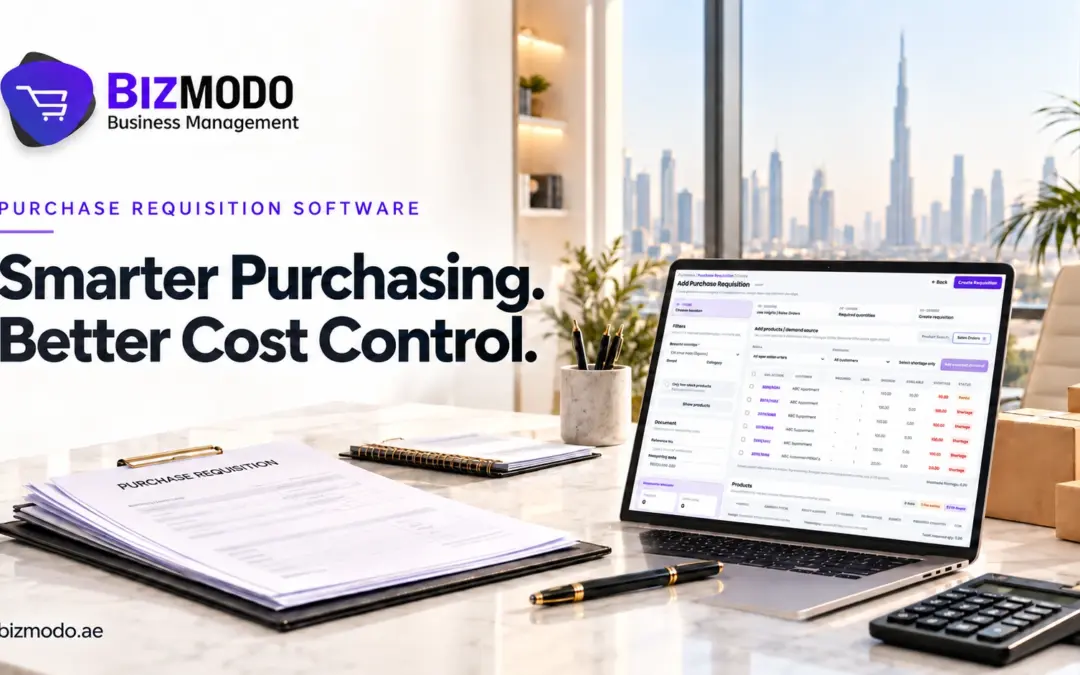
Purchase requisition software cuts procurement costs by putting a simple control in front of every purchase: someone asks, the right person checks stock and budget, and only then does an order reach a supplier. For UAE businesses running several branches, a warehouse, or a van fleet, that one step removes duplicate orders, unplanned spending, and the gaps between purchasing, stock, and accounts that make costs hard to see until the month has closed.
This guide explains where procurement money leaks in day-to-day operations, how a purchase requisition system closes those leaks, what to check before you buy, and how BizModo’s connected purchasing, inventory, and accounting tools fit into the picture.
What a Purchase Requisition Software Is, and Why It Comes Before the Order
A purchase requisition software is an internal request to buy something. A store supervisor needs packaging, a kitchen needs another case of oil, or a branch manager wants to replace a barcode scanner. The requisition records what is needed, how much, roughly what it will cost, which branch or department it is for, and why.
A purchase order (PO) is different. It is the external document sent to a supplier once the purchase has been approved. In a well-run process, the requisition is reviewed first and the PO follows. Purchase requisition software digitises that sequence, so requests, approvals, orders, deliveries, and supplier bills sit in one connected record instead of being spread across WhatsApp messages, email threads, and spreadsheets.
Where Procurement Costs Leak in UAE Operations
Most overspending in small and mid-sized businesses is not dramatic. It builds up through routine habits that nobody has time to track.
Disconnected records between purchasing, stock, and accounts
When the person ordering cannot see current stock, they order extra to be safe. When accounts cannot see what was ordered, supplier bills are checked from memory. Each team is working from a different version of the truth, and the cost appears as excess stock, rushed reorders, or disputed invoices.
Informal and duplicate purchasing
Two branches order the same item from the same supplier in the same week. A staff member buys from a nearby shop at retail price because the usual supplier “takes too long”. A manager approves a request verbally and forgets about it. Without a request trail, none of this is visible.
Overstocking and stockouts at the same time
Businesses with several outlets often carry too much of an item in one location and run out of it in another. Buying more fixes the shortage but ties up cash. For food, pharmacy, and seasonal retail, it also increases the risk of expiry and write-offs.
Weak supplier and payment visibility
If supplier orders, deliveries, and payments are tracked separately, it becomes difficult to compare what was ordered, what arrived, and what is being billed. Early payment terms are missed, short deliveries are paid in full, and negotiations with suppliers rely on guesswork rather than purchase history.
Missing purchase records at VAT time
For VAT-registered businesses, purchase records are not just an internal matter. UAE government guidance states that VAT records, including tax invoices and credit notes received, must be kept for at least five years. Supplier invoices lost in an inbox or a drawer make input VAT harder to support and reconcile.
How Purchase Requisition Software Reduces Those Costs
Good purchase requisition software does not save money on its own. It saves money by making the right decision the easy one, at the moment the decision is made.
Visibility before spending
The most useful cost control happens before the order is placed. When purchase requisition software shows current stock at that branch, stock at other branches, and recent purchase prices, the approver can ask a simple question: do we need to buy this at all, or can we transfer it? In multi-branch businesses, a stock transfer is often cheaper and faster than a new order.

Approval rules that match spending risk
Purchase requisition software can route low-value, routine requests quickly while sending larger or unusual purchases to a senior approver. This keeps the process light for everyday items and puts attention where the money is. Clear rules also reduce the delays that push staff into informal buying.
Consolidated orders and better supplier terms
When purchase requisition software shows requests from several branches in one place, purchasing can combine them into fewer, larger orders. That can mean better unit prices, fewer delivery charges, and a stronger position when discussing terms. It also builds a purchase history for each supplier, which is the evidence you need to negotiate.
Matching orders, deliveries, and bills
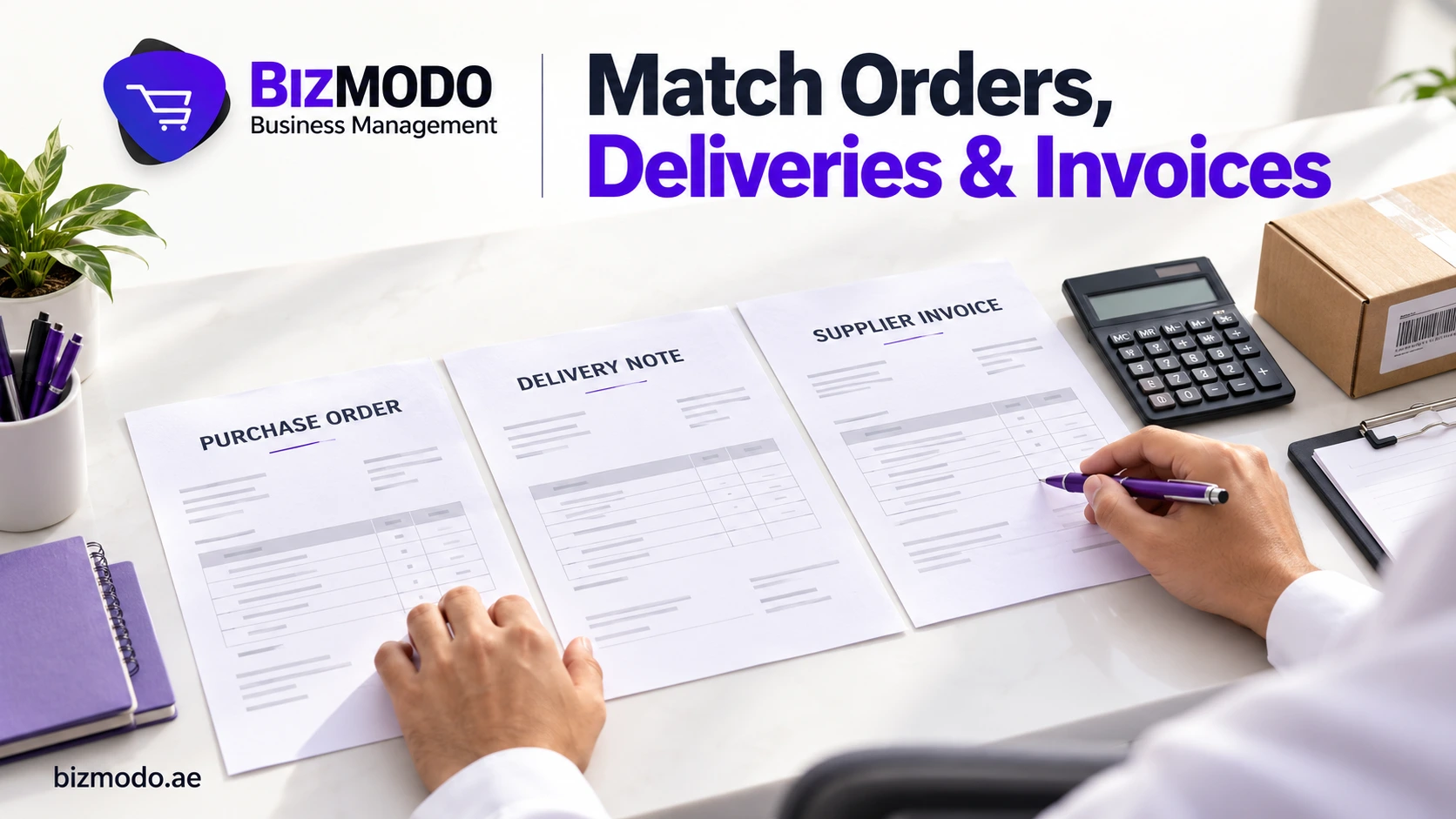
Once the order is approved, the same record in your purchase requisition software should follow the goods in and the bill through to payment. Matching what was requested, ordered, received, and invoiced catches price changes, short deliveries, and duplicate bills before they are paid.
A cleaner audit trail
In purchase requisition software, every request, approval, and change is timestamped and linked to a user. That supports internal reviews, makes month-end faster for the accounts team, and keeps supplier documents organised for VAT reporting.
A Worked Example: Three Branches, One Purchasing Process
The following is a hypothetical example to illustrate the calculation. It is not a BizModo customer result.
Consider a retail business with three branches and a small central store, spending around AED 80,000 a month on stock and consumables. Branch supervisors handle purchasing by messaging suppliers directly.
A quick review of three months of bills shows a familiar pattern. Two branches ordered some items in the same week. A few emergency purchases were made from a local shop at higher prices. One branch held more than two months of stock on slow-moving lines while another was reordering the same items.
Suppose that duplicate orders, emergency buying, and avoidable reorders account for 4% of monthly spend. That is AED 3,200 a month, or AED 38,400 a year. Suppose introducing purchase requisition software, stock visibility across branches, and a single approval step removed half of that. The business would keep around AED 19,200 a year, before counting the time saved on reconciling supplier bills.
Your own figures will differ. The point of the exercise is to measure your current leakage first, so you can judge any procurement management software against a real baseline rather than a vendor’s promise.
What to Verify Before Choosing Purchase Requisition Software
Feature lists for purchase requisition software can look similar across vendors. These questions separate a useful system from one that adds admin.
- Stock visibility at the point of request. Can the requester and approver see live stock per branch or warehouse before they approve?
- Approval flexibility. Can approval rules be set by amount, branch, department, or item category, and can approvals be done from a phone?
- Branch transfers. Can an approved need be fulfilled through an internal stock transfer instead of a new purchase?
- Supplier records. Are supplier orders, payments, and account balances held in the same system as stock and accounts?
- VAT handling on purchases. Does the system record VAT on purchases and report input VAT, so supplier bills flow into your VAT reporting?
- User roles and audit logs. Can you limit who requests, who approves, and who pays, and can you see who did what?
- Reporting. Can you report spend by supplier, branch, and category without exporting to a spreadsheet?
- E-invoicing readiness. The UAE Ministry of Finance has issued Ministerial Decisions setting out a phased rollout of the national e-invoicing system. Ask how the vendor plans to support it. Confirm the timeline that applies to your business directly with the Ministry of Finance or your tax adviser.
No software guarantees tax compliance. It can keep records organised and calculations consistent, but responsibility for correct VAT treatment and filing stays with the business and its advisers.
Common Mistakes When Introducing a Purchase Requisition System
Making approvals too heavy. If every AED 50 purchase needs a director’s sign-off, staff will find ways around the process. Start with one or two thresholds in your purchase requisition software and adjust after a month.
Ignoring stock data. A purchase requisition system that cannot see inventory only digitises the old guesswork. Requisitions and stock should live in the same system or be tightly connected.
Leaving suppliers outside the process. If orders still go out by phone or message after approval, the trail breaks. The approved request in your purchase requisition software should become the order record.
Skipping the baseline. Without knowing your current spend per branch and supplier, you will not be able to tell whether the new process is working.
Treating rollout as a software task only. Staff need to know who approves what and why. A short internal guide and a two-week trial at one branch usually surface problems faster than a company-wide launch.
Where BizModo Fits
BizModo is a cloud-based ERP and point of sale (POS) platform built for UAE businesses. Rather than treating procurement in isolation, it connects purchasing to the stock and accounts that purchasing affects. That connection is where many of the cost leaks above begin.
Based on BizModo’s published product information, the platform includes:
- Inventory management across branches, with stock adjustments, low-stock alerts, and the ability to transfer stock between branches.
- Supplier management, with supplier orders, payments, and vendor accounts handled in one place.
- Purchases and VAT, with 5% VAT calculated on sales and purchases, input and output VAT tracking, and VAT summary reports, as described on the BizModo VAT accounting software page.
- User roles and audit logs, so you can give cashiers, accountants, and sales staff different levels of access.
- A centralised chart of accounts and real-time reporting, giving managers a view of performance across locations.
These capabilities address the visibility, supplier, and record-keeping problems described in this article. BizModo’s public pages do not describe a dedicated, multi-level requisition approval workflow. If formal approval routing is essential to you, ask the team to show how your requests and approvals would be handled during a demonstration.
If your purchasing is tied to field sales or multiple outlets, the van sales and retail store POS pages explain how BizModo handles stock on the move and across stores. The pricing page lists the plan options, including which modules are included or optional.
Frequently Asked Questions
Is purchase requisition software only for large companies?
No. Smaller businesses often feel the benefit sooner, because one owner or manager is usually approving everything from memory. A simple digital request and approval step, linked to stock, saves time even with a handful of users.
What is the difference between purchase requisition software and procurement management software?
Purchase requisition software focuses on the internal request and approval stage. Procurement management software usually covers the wider cycle, including supplier management, purchase orders, receiving, and payment. Many businesses get the most value from a system that connects both stages to inventory and accounting.
How long does it take to see savings?
It depends on how much leakage exists today and how consistently the new process is used. Measure spend per branch and supplier before rollout, then review it after one or two months. That gives you a realistic answer for your own business.
Talk to BizModo About Your Purchasing Process
You may be evaluating purchase requisition software because disconnected orders, supplier payments, and stock records are making procurement costs hard to control. If so, the most useful next step is to walk through your current process with someone who can show how it would work in practice. Contact BizModo on WhatsApp or call +971 50 405 9006 to discuss your requirements and request a demonstration of the purchasing, inventory, and VAT tools for your branches.
 BizModo

