

The best HRMS software for a UAE business is the one your employees open without being chased. When staff can request leave, check balances and record attendance in one place, managers approve requests faster, payroll works from accurate data, and HR stops reconciling spreadsheets, WhatsApp messages and paper forms at month-end. Features matter, but adoption decides whether those features ever deliver value.
This guide explains why HR systems often go unused, what disconnected records cost a UAE employer, which capabilities make HRMS software genuinely usable, and how to evaluate options before you commit.
Why HR Systems Fail After Go-Live
Most failed HR rollouts do not fail because the software lacked a module. They fail because the system added work for the people expected to use it.
A supervisor who needs six screens to approve a leave request will approve it on WhatsApp instead. An employee who cannot see their own leave balance will email HR to ask. A branch manager who finds the attendance screen confusing will keep a paper register “just for now.” Within a few months, the business is running two systems: the official one and the real one.
The result is familiar to many operators. HR holds one version of the truth, managers hold another, and payroll is prepared by someone who has to merge both under deadline pressure. Buying HRMS software does not fix that on its own. Choosing software that fits how your people already work, and then removing the old shortcuts, does.
What Disconnected HR Records Cost a UAE Business
Scattered HR data is more than an administrative irritation in the UAE. Several employer obligations depend on accurate, timely records.
Salary timing under the updated Wage Protection System
The Wage Protection System (WPS) is the electronic salary transfer mechanism run by the Ministry of Human Resources and Emiratisation (MOHRE). Establishments registered with MOHRE must pay wages through WPS, using banks, exchange houses or financial institutions authorised by the Central Bank of the UAE. A small number of employer categories are exempt, so check how the rule applies to your licence and business activity.
The timeline is also strict. Under Ministerial Resolution No. 340 of 2026, salaries for the previous month are due on the first day of each Gregorian month, and employers must transfer at least 85% of the total wages due on time. That leaves payroll very little margin for late corrections.
If attendance, overtime and unpaid leave are still being collected from branches in the last week of the month, payroll is working against that date. HRMS software cannot make you compliant by itself, because payment still depends on your bank or WPS agent and your internal approvals. It can, however, give payroll clean inputs earlier.
Leave and end-of-service figures depend on clean data
Under Federal Decree-Law No. 33 of 2021, employees who complete one year of service are entitled to 30 days of fully paid annual leave, with two days per month for service between six months and one year, and unused leave must be paid out when employment ends. When balances are tracked in separate files, disputes over remaining days become common, especially at resignation.
End-of-service gratuity creates similar exposure. A worker who completes at least one year of continuous service is entitled to gratuity, calculated on basic salary at 21 days’ pay for each of the first five years; days of unpaid absence are excluded from the service period, and employers must settle wages, entitlements and gratuity within 14 days after the contract ends. If unpaid leave was approved informally and never recorded, the final settlement may be wrong, and that 14-day window leaves little time to rebuild the history.
Illustrative calculation (hypothetical): an employee with a basic salary of AED 6,000 accrues roughly AED 4,200 of gratuity for each of the first five years, using a daily rate of AED 200. If 20 days of unpaid leave were never logged, the service period used in the calculation is overstated. The amount is small for one person, but across a workforce of 60 and several years, informal records add up. Confirm the exact method with your adviser or MOHRE guidance.
What Makes HRMS Software Easy for Employees to Use
Usability is not a single feature. It is the sum of small decisions that reduce friction for three groups: employees, line managers and HR or payroll staff.
For employees: answers without asking HR
Employees use a system when it answers their own questions. The most valuable self-service actions are simple: submitting a leave request, seeing whether it has been approved, checking remaining leave and viewing attendance records. If an employee still has to message HR to learn their balance, the system has not replaced the old process.
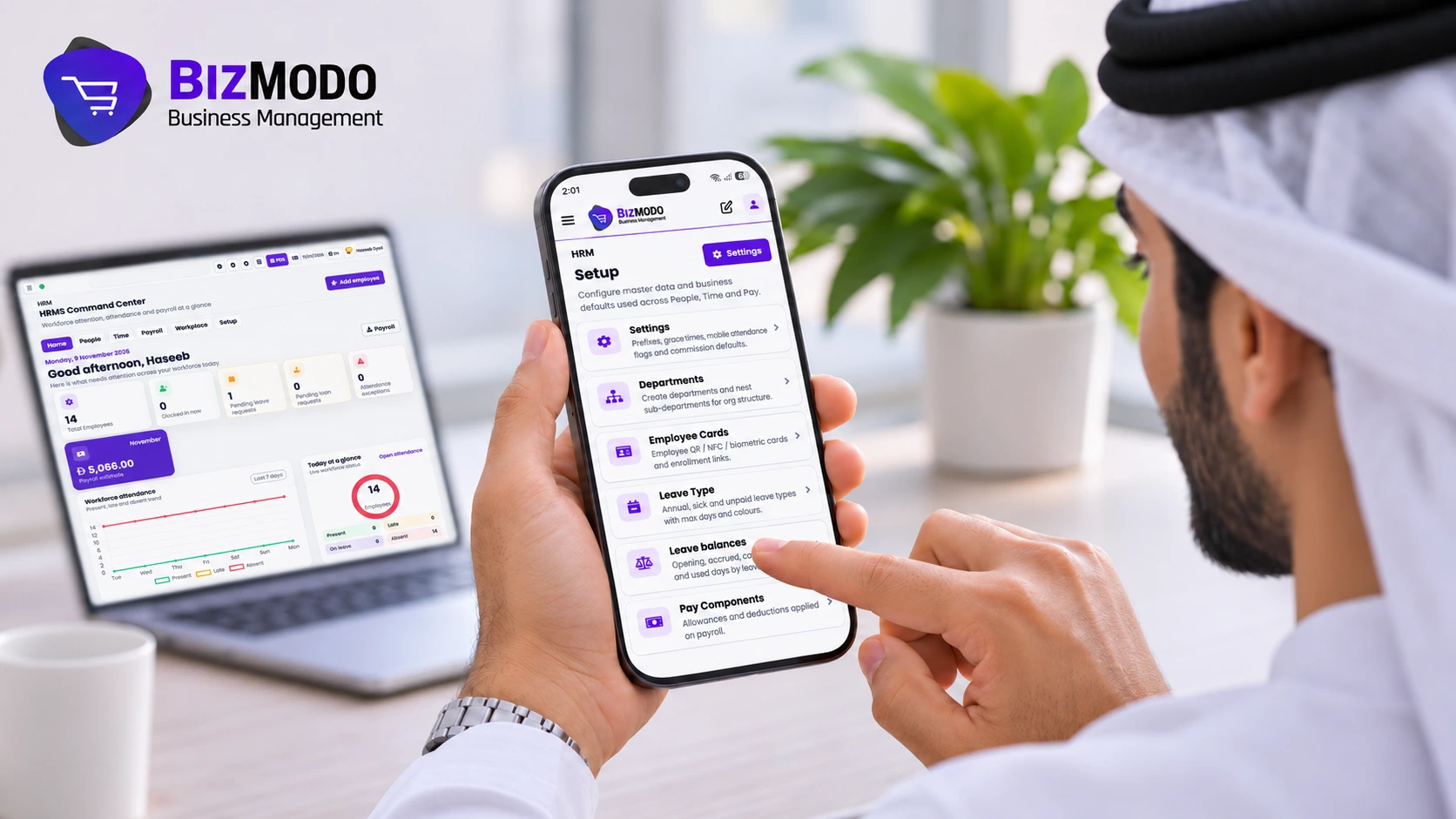
For managers: fast approvals in context
Managers need to approve or reject requests quickly, with enough context to decide well. That means seeing who else in the department is already on leave that week, rather than approving blindly. Department-level visibility matters most in businesses with several branches, where a manager may not see every team member every day.
For HR and payroll: one record, many uses
For the HR team, usability means entering data once. An employee’s department, job title, salary details, leave history and attendance should sit in one profile that payroll can draw from. When HRMS software connects attendance capture, leave and payroll, month-end becomes a review rather than a reconstruction.
For everyone: low training burden
If a system needs a two-day course before a cashier or driver can use it, adoption will stall. Ask how many steps common tasks take and whether the interface works on the devices your teams actually carry. For multilingual workforces, ask which interface languages are available for the HR screens specifically.
A Realistic Workflow: From Leave Request to Payroll
The following is a hypothetical example, not a BizModo customer case.
A trading company employs 45 staff across a head office and two retail branches. Before using HRMS software, branch supervisors recorded attendance on paper, leave requests came through WhatsApp, and the HR officer spent the final days of each month chasing confirmations before passing figures to the accountant.
After implementation, the process looks like this:
- An employee submits a leave request in the system, and the request shows their current balance.
- The branch supervisor reviews it alongside the department’s existing approved leave and approves it.
- The approved leave updates the employee’s balance and attendance records automatically.
- Attendance data from the branch time-attendance device flows into the same employee records.
- At month-end, HR reviews exceptions such as unapproved absences or missing punches, rather than rebuilding every record.
- Payroll is prepared from approved attendance and leave data, leaving time to resolve issues before the WPS deadline.
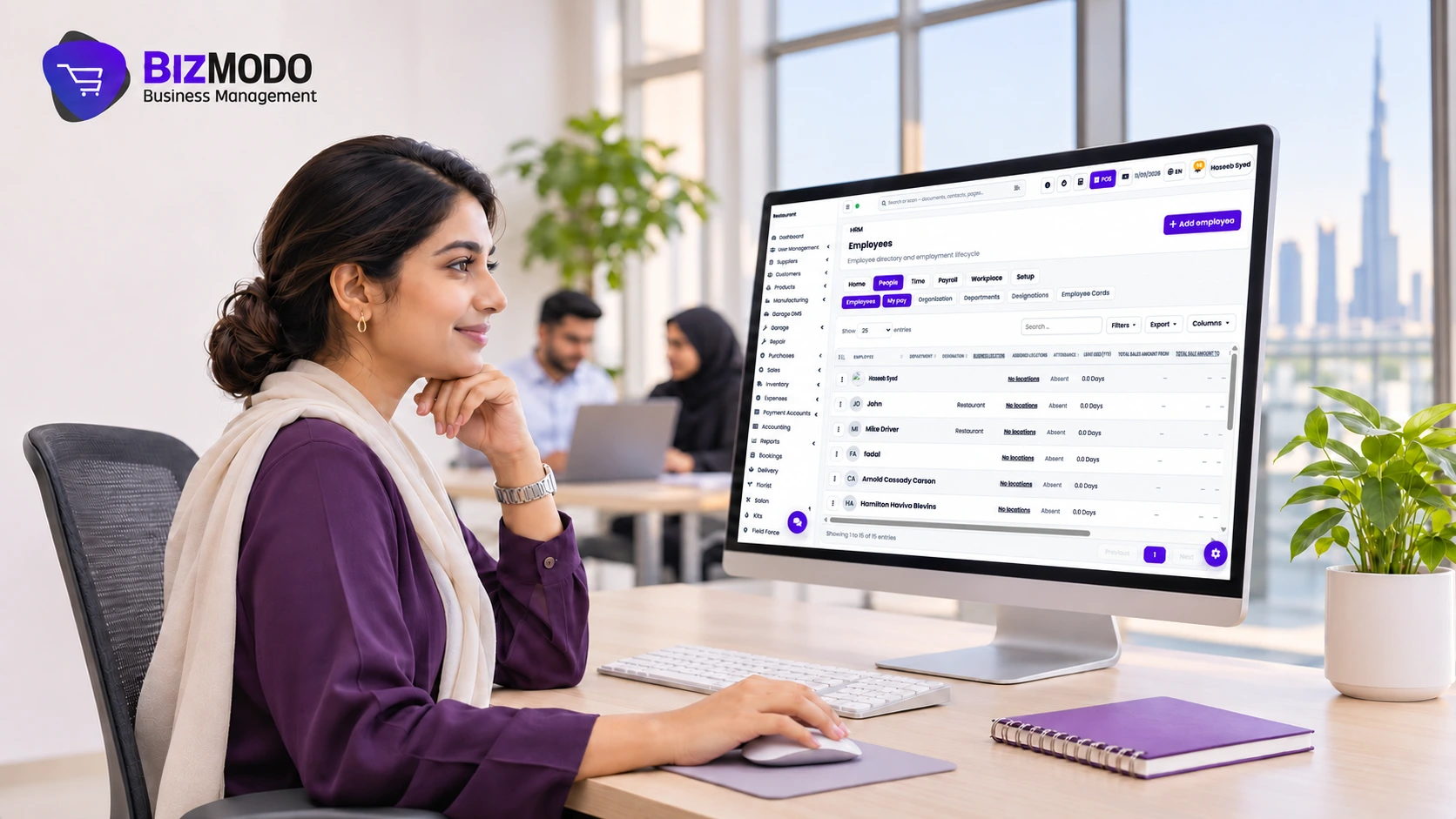
The improvement does not come from any one step. It comes from the leave request, the approval and the payroll input living in the same record, so nobody re-keys them.
How to tell whether people are actually using it
Adoption can be measured rather than assumed. Ninety days after launch, check what share of leave requests were submitted through the HRMS software rather than by message, how many attendance exceptions HR corrected manually, and how long month-end preparation took compared with before. If requests still arrive outside the system, find out which step is causing friction and fix that step, instead of adding more rules. Well-chosen HRMS software should make the official process the easiest one to follow.
How to Choose the Best HRMS Software for Your Business
There is no universal answer to which product is the best HRMS software. The right choice depends on headcount, number of locations, how payroll is processed today and how comfortable your teams are with digital tools. These criteria help narrow the field.
- Test the employee journey, not just the admin panel. In a demo, ask the vendor to submit a leave request as an employee and approve it as a manager. Count the clicks.
- Check how attendance is captured. Confirm whether the system integrates with time-attendance devices you already own, and what happens when a device goes offline.
- Trace the path to payroll. Ask how approved leave, unpaid leave and attendance feed salary calculations, and how the output supports your WPS process through your bank or agent. Do not assume a vendor generates WPS salary files unless they confirm it in writing.
- Look at multi-branch structure. If you operate several sites, check that departments, branches and reporting lines can be modelled accurately.
- Consider the wider system. HR data is more useful when it connects to accounting, sales and operations. Running HR inside the same platform as your POS or ERP can reduce duplicate records.
- Ask about data ownership and exports. You should be able to export employee records and history if you change providers.
- Understand pricing in AED and what is included. Clarify whether pricing is per user, per employee or per module, and whether implementation and training are extra.
When businesses search for HRMS software Dubai options, they often compare long feature lists. A shorter list of features your staff will use daily is usually more valuable than a long list nobody opens.
Common Mistakes When Rolling Out HRMS Software
Migrating messy data. Importing outdated leave balances or duplicate employee records simply moves the problem into a new system. Clean the data first, and have employees confirm their opening balances.
Keeping the old channels open. If managers can still approve leave on WhatsApp, many will. Set a clear cut-over date after which only system requests count.
Configuring everything at once. Start with employee records, attendance and leave. Add performance reviews or recruitment workflows once the core process is stable.
Skipping manager training. Employees follow their supervisors. If managers do not use the system confidently, nobody else will.
Treating software as compliance. HRMS software supports accurate records, but labour law obligations remain the employer’s responsibility. Review contracts, policies and payment processes separately.
Where BizModo HRMS Fits
BizModo’s HRMS module is built into a cloud-based business platform that also covers point of sale, inventory, accounting and CRM. Based on the service page, its HR capabilities include:
- Central employee records, including contact details, job titles and performance information
- Departments for organising staff and reporting
- Attendance tracking, with time-attendance integration
- Leave management, where employees request leave in the system and leave balances are tracked
- Payroll
- Performance tracking, including reviews and development plans
- Sales targets for customer-facing teams
- Support for recruitment, onboarding and termination workflows
For businesses already using BizModo for retail, restaurant or service operations, the practical advantage is having HR data in the same environment as sales and accounting rather than in a separate tool. You can also review the VAT accounting module and CRM to see how other modules connect.
As with any HRMS software, verify the details that matter to your operation during a demonstration. Useful questions include which time-attendance devices are supported, how payroll output fits your WPS process, which languages the HR screens offer, and how the employee experience works on mobile devices. Current plans are listed on the pricing page.
Frequently Asked Questions
Is HRMS software worth it for a small UAE business?
For a team of 10 to 15 people in one location, a well-kept spreadsheet may be manageable. Once you have multiple branches, shift-based staff or frequent leave requests, the time spent reconciling records usually justifies dedicated HRMS software.
Does HRMS software handle WPS payments?
Salaries are paid through WPS via banks, exchange houses or financial institutions authorised by the Central Bank of the UAE. HRMS software prepares accurate payroll inputs, and some systems export salary files. Confirm exactly what a vendor provides before relying on it.
How long does implementation take?
It depends on headcount, data quality and how many modules you start with. Ask vendors for a realistic plan based on your data, rather than a generic estimate.
Discuss Your HR Requirements With BizModo
If your team is still managing leave on messaging apps and rebuilding attendance at month-end, a short conversation can show whether BizModo HRMS fits your workflow. Contact BizModo or call +971 50 405 9006 to discuss your requirements and request a demonstration based on your own branches, departments and leave policies.